We the Diverse People:
Cultural Encounters in the Pacific Northwest
2004 Engaging the American Past Summer Institute
Teaching America’s Multicultural History
Dr. Lois Leveen
History Programs Coordinator, ESD 112
360-750-7505 x 205
HOW TO TELL YOUR FRIENDS FROM THE JAPS
Of these four faces of young men (above) and middle-aged men (below), the two on the left are Chinese, and the two on the right Japanese. There is no infallible way of telling them apart, because the same racial strains are mixed in both. Even an anthropologist, with calipers and plenty of time to measure heads, noses, shoulders, hips, is sometimes stumped. A few rules of thumb -- not always reliable:
• Some Chinese are tall (average: 5 ft. 5 in.). Virtually all Japanese are short (average: 5 ft. 2.5 in.).
• Japanese are likely to be stockier and broader-hipped than short Chinese.
• Japanese -- except for wrestlers -- are seldom fat; they often dry up and grow lean as they age. The Chinese often put on weight, particularly if they are prosperous (in China, with its frequent famines, being fat is esteemed as a sign of being a solid citizen).
• Chinese, not as hairy as Japanese, seldom grow an impressive mustache.
• Most Chinese avoid horn-rimmed spectacles.
• Although both have the typical epicanthic fold on the upper eyelid (which makes them look almond-eyed), Japanese eyes are usually set closer together.
• Those who know them best often rely on facial expression to tell them apart: the Chinese expression is likely to be more placid, kindly, open; the Japanese more positive, dogmatic, arrogant.
In Washington last week, correspondent Joseph Chiang made things much easier by pinning on his lapel a large badge reading "Chinese Reporter -- NOT Japanese -- Please."
• Some aristocratic Japanese have thin, aquiline noses, narrow faces, and except for their eyes, look like Caucasians.
• Japanese are hesitant, nervous in conversation, laugh loudly at the wrong time.
• Japanese walk stiffly erect, hard-heeled. Chinese, more relaxed, have an easy gait, sometimes shuffle
(from Time magazine, 22 December 1941)
How To Tell Japs From The Chinese
Angry Citizens Victimize Allies With Emotional Outburst At Enemy
In the first discharge of emotions touched off by the Japanese assaults on their nation, U.S. citizens have been demonstrating a distressing ignorance on the delicate question of how to tell a Chinese from a Jap. Innocent victims in cities all over the country are many of the 75,000 U.S. Chinese, whose homeland is our stanch ally. So serious were the consequences threatened, that the Chinese consulates last week prepared to tag their nationals with identification buttons. To dispel some of this confusion, LIFE here adduces a rule-of-thumb from the anthropometric conformations that distinguish friendly Chinese from enemy alien Japs.
To physical anthropologists, devoted debunkers of race myths, the difference between Chinese and Japs is measurable in millimeters. Both are related to the Eskimo and North American Indian. The modern Jap is the descendant of Mongoloids who invaded the Japanese archipelago back in the mists of prehistory, and of the native aborigines who possessed the islands before them. Physical anthropology, in consequence, finds Japs and Chinese as closely related as Germans and English. It can, however, set apart the special types of each national group.
The typical Northern Chinese, represented by Ong Wen-hao, Chungking’s Minister of Economic Affairs (left, above), is relatively tall and slenderly built. His complexion is parchment yellow, his face long and delicately boned, his nose more finely bridged. Representative of the Japanese people as a whole is Premier and General Hideki Tojo (left, below), who betrays aboriginal antecedents in a squat, long-torsoed build, a broader, more massively boned head and face, flat, often pug, nose, yellow-ocher skin and heavier beard. From this average type, aristocratic Japs, who claim kinship to the Imperial Household, diverge sharply. They are proud to approximate the patrician lines of the Northern Chinese.
Chinese public servant, Ong Wen-hao, is representative of Northern Chinese anthropological group with long, fine-boned face and scant beard. Epicanthic fold of skin above eyelid is found in 85% of Chinese. Southern Chinese have round, broad faces, not as massively boned as the Japanese. Except that their skin is darker, this description fits Filipinos who are often mistaken for Japs. Chinese sometimes pass for Europeans; but Japs more often approach Western types.
Japanese warrior, General Hideki Tojo, current Premier, is a Samurai, closer to type of humble Jap than highbred relatives of Imperial Household. Typical are his heavy beard, massive cheek and jaw bones. Peasant Jap is squat Mongoloid, with flat, blob nose. An often sounder clue is facial expression, shaped by cultural, not anthropological, factors. Chinese wear rational calm of tolerant realists. Japs, like General Tojo, show humorless intensity of ruthless mystics.
Chinese journalist, Joe Chiang, found it necessary to advertise his nationality to gain admittance to White House press conference. Under Immigration Act of 1924, Japs and Chinese, as members of the "yellow race," are barred from immigration and naturalization.
Tall Chinese brothers, full length, show lanky, lithe build of northern anthropological group that has suffered most in China’s recent history from flood, famine and war with Japs. Average height of Northern Chinese is 5 ft. 7 in., sometimes exceeds 6 ft. Most Chinese in America come from southern and coastal cities, Canton and Shanghai. They are shorter than Northern Chinese, but retain the slight proportions of the young men shown here. When middle-aged and fat, they look more like Japs.
Short Japanese admirals, full length, exhibit the squat, solid, long torso and short stocky legs of the most numerous Japanese anthropological group. Since Navy is relatively new and junior service, Jap naval officer corps numbers fewer Samurai, has more of the round-faced, flat-nosed peasant type. Over 6 ft. tall, Admiral Nomura shows traits of the big, fair-skinned hairy Ainu, aborigines who still live on reservations in Northern Japan. Special Emissary Kurusu, also atypical, looks European.
(From LIFE Magazine 22 December 1941, Vol. 11, No. 25, pp.81-82)
White Privilege: Unpacking the Invisible Knapsack By Peggy McIntosh
I was taught to see racism only in individual acts of meanness, not in invisible systems conferring dominance on my group
Through work in women's studies, I have often noticed men's unwillingness to grant that they are overprivileged, even though they may grant that women are disadvantaged. They may say they will work to improve women's status, in the society, the university, or the curriculum, but they can't or won't support the idea of lessening men's. Denials that amount to taboos surround the subject of advantages that men gain from women's disadvantages. These denials protect male privilege from being fully acknowledged, lessened, or ended.
Thinking through unacknowledged male privilege as a phenomenon, I realized that, since hierarchies in our society are interlocking, there are most likely a phenomenon of while privilege that was similarly denied and protected. As a white person, I realized I had been taught about racism as something that puts others at a disadvantage, but had been taught not to see on of its corollary aspects, white privilege, which puts me at an advantage.
I think whites are carefully taught not to recognize white privilege, as males are taught not to recognize male privilege. So I have begun in an untutored way to ask what it is like to have white privilege. I have come to see white privilege as an invisible package of unearned assets that I can count on cashing in each day, but about which I was "meant" to remain oblivious. White privilege is like an invisible weightless knapsack of special provisions, maps, passports, codebooks, visas, clothes, tools , and blank checks.
Describing white privilege makes one newly accountable. As we in Women's Studies work to reveal male privilege and ask men to give up some of their power, so one who writes about having white privilege must ask, "Having described it, what will I do to lessen or end it?"
After I realized the extent to which men work from a base of unacknowledged privilege, I understood that much of their oppressiveness was unconscious. Then I remembered the frequent charges from women of color that white women whom they encounter are oppressive. I began to understand why we are justly seen as oppressive, even when we don't see ourselves that way. I began to count the ways in which I enjoy unearned skin privilege and have been conditioned into oblivion about its existence.
My schooling gave me no training in seeing myself as an oppressor, as an unfairly advantaged person, or as a participant in a damaged culture. I was taught to see myself as an individual whose moral state depended on her individual moral will. My schooling followed the pattern my colleague Elizabeth Minnich has pointed out: whites are taught to think of their lives as morally neutral, normative, and average, and also ideal, so that when we work to benefit others, this is seen as work which will allow "them" to be more like "us".
I decided to try to work on myself at least by identifying some of the daily effects of white privilege in my life. I have chosen those conditions which I think in my case attach somewhat more to skin color privilege than to class, religion, ethnic status, or geographical location, though of course all these other factors are intricately intertwined. As far as I can see, my African American coworkers, friends and acquaintances with whom I come into daily or frequent contact in this particular time, place, and line of work cannot count on most of these conditions.
I usually think of privilege as being a favored state, whether earned or conferred by birth or luck. Yet some of the conditions I have described here work to systematically overempower certain groups. Such privilege simply confers dominance because of one's race.
1. I can if I wish arrange to be in the company of people of my race most of the time.
2. If I should need to move, I can be pretty sure renting or purchasing housing in an area which I can afford and in which I would want to live.
3. I can be pretty sure that my neighbors in such a location will be neutral or pleasant to me.
4. I can go shopping alone most of the time, pretty well assured that I will not be followed or harassed.
5. I can turn on the television or open to the front page of the paper and see people of my race widely represented.
6. When I am told about our national heritage or about "civilization," I am shown that people of my color made it what it is.
7. I can be sure that my children will be given curricular materials that testify to the existence of their race.
8. I can be pretty sure of having my voice heard in a group in which I am the only member of my race.
9. I can go into a music shop and count on finding the music of my race represented, into a supermarket and find the staple foods which fit with my cultural traditions, into a hairdresser's shop and find someone who can cut my hair.
10. Whether I use checks, credit cards, or cash, I can count on my skin color not to work against the appearance of financial reliability.
11. I can arrange to protect my children most of the time from people who might not like them.
12. I do not have to educate my children about systemic racism for their own daily physical protection.
13. I do not have to worry that my children’s teachers or employers will treat them differently because of their race.
14. I can talk with my mouth full and not have people put this down to my color.
15. I can swear, or dress in second hand clothes, or not answer letters, without having people attribute these choices to the bad morals, the poverty, or the illiteracy of my race.
16. I can speak in public to a powerful male group without putting my race on trial.
17. I can do well in a challenging situation without being called a credit to my race.
18. I am never asked to speak for all the people of my racial group.
19. I can remain oblivious of the language and customs of persons of color who constitute the world's majority without feeling in my culture any penalty for such oblivion.
20. I can criticize our government and talk about how much I fear its policies and behavior without being seen as a cultural outsider.
21. I can be pretty sure that if I ask to talk to "the person in charge," I will be facing a person of my race.
22. If a traffic cop pulls me over or if the IRS audits my tax return, I can be sure I haven't been singled out because of my race.
23. I can easily buy posters, postcards, picture books, greeting cards, dolls, toys, and children's magazines featuring people of my race.
24. I can go home from most meetings of organizations I belong to feeling somewhat tied in, rather than isolated, out-of-place, out numbered, unheard, held at a distance, or feared.
25. If I declare there is a racial issue at hand, or if I argue that there isn’t a racial issue at hand, my race will lend me more credibility for either position than a person of color will have.
26. My culture does not discourage me from ignoring the perspectives of people of other races.
27. I am not afraid my shape, bearing, or body odor will be taken as a reflection of my race.
28. I can speak out against racism without being seen as self-interested or self-seeking.
29. I can take a job with an affirmative action employer without having coworkers on the job suspect that I got it because of race.
30. I can choose public accommodation without fearing that people of my race cannot get in or will be mistreated in the places I have chosen.
31. I can be sure that if I need legal or medical help, my race will not work against me.
32. I can easily find classes and schools that give attention primarily or solely to people of my race.
33. I can consider many social, political, or professional options, without having to worry about whether a person of my face would be accepted or allowed to do what I want to do.
34. I can be late to a meeting without my lateness being seen as a reflection on my race.
35. If I am a poor leader, no one will assume that my race is the reason.
36. If my day, week, or year is going badly, I need not ask of each negative episode or situation whether it has racial overtones.
I repeatedly forgot each of the realizations on this list until I wrote it down. For me white privilege has turned out to be an elusive and fugitive subject. The pressure to avoid it is great, for in facing it I must give up the myth of meritocracy. If these things are true, this is not such a free country; one's life is not what one makes it; many doors open for certain people through no virtues of their own.
In unpacking this invisible knapsack of white privilege, I have listed conditions of daily experience which I once took for granted. Nor did I think of any of these prequisites as bad for the holder. I now think that we need a more finely differentiated taxonomy of privilege, for some of these varieties are only what one would want for everyone in a just society, and others give license to be ignorant.
I see a pattern running through the matrix of white privilege, a pattern of assumptions which were passed on to me as a white person. There was one main piece of cultural turf; it was my own turf, and I was among those who could control the turf. My skin color was an asset for any move I was educated to want to make. I could think of myself as belonging in major ways, and of making social systems work for me. I could freely disparage, fear, neglect, or be oblivious to anything outside of the dominant cultural forms. Being of the main culture, I could also criticize it fairly freely.
As my racial group was being made confident, comfortable, and oblivious, other groups were likely being made unconfident, uncomfortable, and alienated. Whiteness protected me from many kinds of hostility, distress, and violence, which I was being subtly trained to visit in turn upon people of color. For this reason, the word "privilege" now seems to me misleading. We want, then, to distinguish between earned strength and unearned power conferred systematically. Power from unearned privilege can look like strength when it is in fact permission to escape or to dominate. But not all of the privileges on my list are inevitably damaging. Some, like the expectation that neighbors will be decent to you, or that your race will not count against you in court, should be the norm in a just society. Others, like the privilege to ignore less powerful people, distort the humanity of the holders as well as the ignored groups.
We might at least start by distinguishing between positive advantages which we can work to spread, and negative types of advantages which unless rejected will always reinforce our present hierarchies. For example, the feeling that one belongs within the human circle, as Native Americans say, should not be seen as privilege for a few. Ideally it is an unearned entitlement. At present, since only a few have it, it is an unearned advantage for them. This paper results from a process of coming to see that some of the power which I originally saw as attendant on being a human being in the U.S. consisted in unearned advantage and conferred dominance.
I have met very few men who are truly distressed about systemic, unearned male advantage and conferred dominance. And so one question for me and others like me is whether we will be like them, or whether we will get truly distressed, even outraged, about unearned race advantage and conferred dominance and if so, what we will do to lessen them. In any case, we need to do more work in identifying how they actually affect our daily lives. Many, perhaps most, of our white students in the U.S. think that racism doesn't affect them because they are not people of color; they do not see "whiteness" as a racial identity. In addition, since race and sex are not the only advantaging systems at work, we need similarly to examine the daily experience of having age advantage, or ethnic advantage, or physical ability, or advantage related to nationality, religion, or sexual orientation.
Disapproving of the systems won't be enough to change them. I was taught to think that racism could end if white individuals changed their attitudes. But a white skin in the United States opens many doors for whites whether or not we approve of the way dominance has been conferred on us. Individual acts can palliate, but cannot end, these problems.
It seems to me that obliviousness about white advantage, like obliviousness about male advantage, is kept strongly inculturated in the United States so as to maintain the myth of meritocracy, the myth that democratic choice is equally available to all.
Adapted from http://www.utoronto.ca/acc/events/peggy1.htm
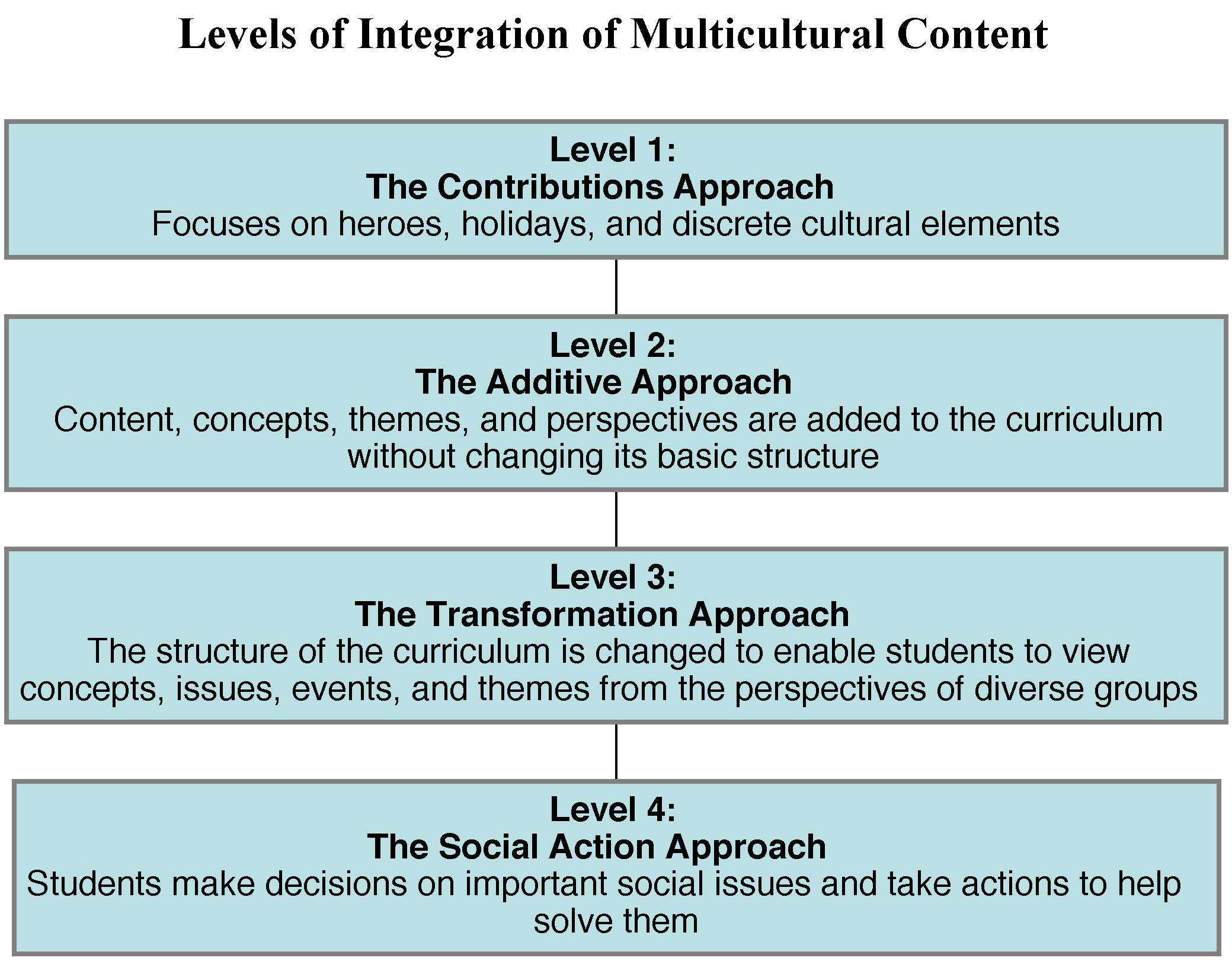
From James Banks, “Approaches to Multicultural Curriculum Reform”