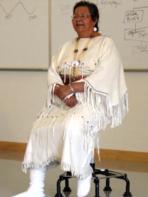
There are a number of books that I use in preparation for the character of Sacagawea and this list represent a few of them as well as some that give examples of projects that could be used in the classroom. |
- Kenneth Thomasma, The Truth about Sacagawea. Jackson, Wyoming: Grandview Publishing Company, 1997.
|
This is a unique little book because Thomasma has picked out all the references to Sacagawea in the Lewis & Clark Journals. He then interprets those incidents in his own way. It is obvious that Ken interprets some of those incidents from a white male point of view and not from the view of a native woman. Be aware of that as you use this book.
|
- Gilbert L. Wilson. Waheenee, An Indians Girl's Story told by herself to Gilbert L. Wilson. Lincoln: University of Nebraska Press, 1981.
|
I picked this book because it describes life among the Hidatsa people in the mid 1800's to the turn of the century. The Hidatsa people (or Minnitares as they were sometimes called) were the ones who captured Sacagawea and she was living with them upon the arrival of the Lewis & Clark Expedition. It gives one good glimpse of the role of women within that tribal structure.
|
- Monte Smith, Traditional Indian Crafts. Ogden, Utah: Eagle's View Publishing Company 706 W. Riverdale Road, Ogden Utah 84405, 1986.
|
This is a "how-to" book of American Indian crafts and gives some rather simple methods for making leather pouches, chokers, breastplates and medicine wheels. Students could make these as part of class projects and it would give them a sense of respect for such cultural items.
|
- Carolyn Gilman and Mary Jane Schneider, The Way to Independence. St. Paul: Minnesota Historical Society Press, 1987.
|
This book is the catalog of a museum exhibit of the same name. This catalog depicts artifacts from the Hidatsa people and namely Waheenee's Tribe and family. Remember that these are the people who captured Sacagawea and who helped the Lewis & Clark Expedition for their winter at Fort Mandan. This catalog shows things from the Hidatsa people's life in their earth lodge villages.
|
- C. Keith Wilbur, M.D., Indian handcrafts: How to Craft Dozens of Practical Objects Using Traditional Indian Techniques. Guilford, ST: the Globe Pequot Press, 2001.
|
I picked this book because of its good examples of making such items as bows and arrows, points, decoys, lodges, canoes, finger woven belts, shirts, moccasins, pottery, gardening, and children's toys. All can be made in the classrooms and may be of interest to students.
|
- Yvonne Y. Merrill, Hands-On Rocky Mountains: Art Activities About Anasazi, American Indians, Settlers, Trappers, and Cowboys. KITS Publishing, 2359 E. Bryan Avenue, Salt Lake City, Utah 84108, 2001.
|
This is a relatively new book and does a good job of illustrating how to make a number of craft items from both the Europeans colonists to the American Indians.
|
- Yvonne Y. Merrill, Hands-On Rocky Mountains: Art Activities About Vikings, Woodland Indian, and Early Colonists. KITS Publishing, 2359 E. Bryan Avenue, Salt Lake City, Utah 84108, 2001.
|
As one might have guessed, this publishing company has several kits or books that consist of art activities, but thinking of it only in terms of art may be a mistake. Some of these items take knowledge of science and math and geometry as well as creativity. And even though this is labeled for Woodland Indians, there are items regarding hairstyles, canoes, pottery, leggings, and the like that transition boundary lines.
|